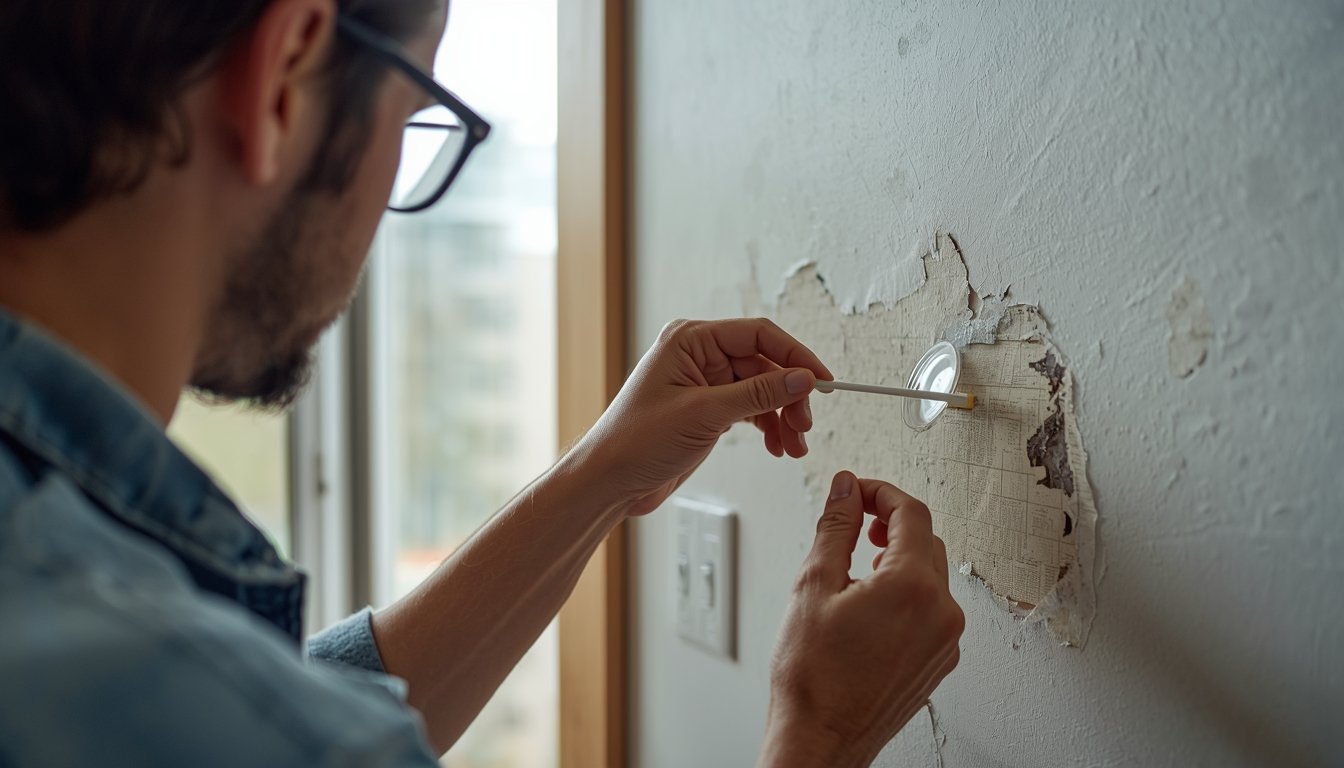
Mold test kits can be reasonably accurate for home use, but their accuracy depends on the type of kit, how it is used, and what question you are trying to answer. They can help show whether mold may be present, but they do not always identify the full extent of a problem or confirm exactly what is happening behind walls, under floors, or in hidden areas.
For most homeowners, a mold test kit is best understood as a screening tool. It can be useful for checking a suspicious area or comparing conditions in different parts of the home, but it is not the same as a full professional inspection.
How It Works
Home mold test kits generally work by collecting a sample from air, a surface, or a visible material. Some use petri dishes to collect settling spores from the air, while others use swabs or tape lifts to sample a visible area.
The idea is to gather evidence of mold activity in a specific place. Depending on the kit, the result may be a visible growth pattern, a color change, or a sample that is interpreted based on instructions provided with the kit.
What It Can Do
- Help confirm whether mold may be present in a visible or suspicious area
- Provide a basic comparison between different rooms or surfaces
- Support a first-step decision when a homeowner is unsure whether a concern is worth investigating further
- Be useful for visible spots, musty areas, or rooms with recurring moisture issues
Limitations / What It Cannot Do
Mold test kits do not measure every part of a mold problem. A positive result does not always tell you how serious the issue is, and a negative result does not always mean there is no mold anywhere in the home.
They also cannot reliably show how far mold has spread into hidden spaces. If mold is behind drywall, under flooring, inside insulation, or deep inside ducting, a home kit may miss that.
Another limitation is interpretation. Results depend on how well the sample was collected, where it was taken, and whether the user understands what the result actually means. A kit may show mold activity in one spot without showing whether that spot is part of a larger moisture problem.
When It Works Best
Mold test kits tend to work best when the concern is limited and specific. For example, they can be helpful when checking a visible patch on a wall, a suspicious area near a window, a bathroom problem spot, or a room with recurring dampness.
They are also more useful when the goal is simple screening rather than a complete diagnosis. In a home setting, they work best when you want to answer a practical question such as whether a visible area likely involves mold or whether one room seems more affected than another.
Common Misconceptions
One common misunderstanding is that a home mold test kit can fully diagnose a house. It cannot. It can provide useful information, but it does not replace every kind of inspection or reveal every hidden condition.
Another misconception is that all mold test kits are equally accurate. They are not. Different kits collect different types of information, and some are better suited to visible surfaces while others are better for general screening.
It is also incorrect to assume that one result tells the whole story. Mold problems are closely tied to moisture, airflow, and building conditions, so a single sample may not represent the full situation.
Final Answer Summary
Yes, mold test kits can be accurate enough for home use when used as a basic screening tool, especially for visible spots or simple room-to-room checks. Their accuracy is more limited when the problem is hidden, widespread, or affected by sampling errors.
The most realistic way to view them is as a practical first step. They can help support a decision, but they do not provide a complete picture of every mold problem in a house.