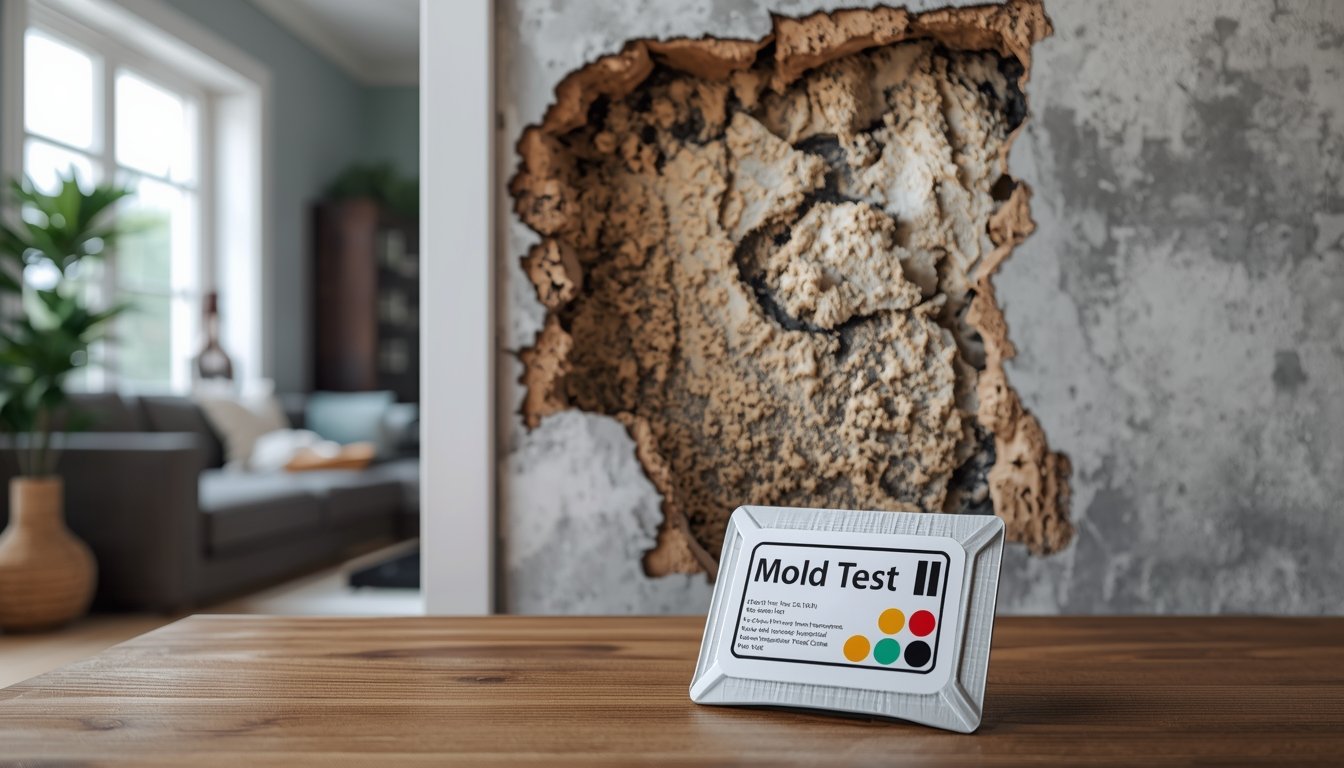
Mold test kits cannot detect every hidden mold problem, every mold type in a house, or the full extent of a moisture issue. They can show mold activity in the sample collected, but they do not give a complete picture of what may be happening behind walls, under floors, inside insulation, or throughout the home.
This means a mold test kit is useful for screening, but not for complete detection. What it cannot detect is often just as important as what it can detect.
How It Works
Mold test kits collect a sample from air, a surface, or a visible material. The result is based only on what that sample contains at the time it was taken.
If mold is present somewhere else in the house, or if it was not captured in the sample, the kit will not show it. The result is limited to the tested area and the method used.
What It Can Do
- Show whether mold may be present in a sampled area
- Help check a visible patch, suspicious surface, or damp room
- Provide a basic comparison between one room or location and another
- Support a first-step decision about whether a concern may need more attention
Limitations / What It Cannot Do
Mold test kits cannot reliably detect hidden mold that was not sampled. If mold is behind drywall, under carpet, inside insulation, beneath flooring, or inside closed building cavities, the kit may miss it completely.
They also cannot fully detect the extent of a mold problem. A positive result may show that mold is present in one place, but it does not show how far the issue has spread or whether it is part of a larger problem in the house.
Another limit is that mold test kits cannot reliably detect the source of moisture. They may show mold activity, but they do not explain whether the cause is a leak, condensation, poor ventilation, or long-term dampness.
Many kits also cannot clearly identify every mold type present. Some may only show that mold is growing or that a sample contains mold activity without giving a full explanation of what species are involved.
They also cannot detect future risk. A house may have conditions that support mold growth, such as humidity or poor airflow, even if a current sample does not show a significant result.
Finally, they cannot replace full interpretation. A kit result does not reliably explain severity, health relevance, building damage, or the exact reason mold is present.
When It Works Best
Mold test kits work best when the question is narrow. They are useful when checking one visible patch, one suspicious area, or one room with a clear moisture concern.
They also work best when used as a screening tool rather than a complete investigation tool. In practical use, they are most helpful when the goal is to gather basic information, not to fully map every mold issue in a home.
Common Misconceptions
One misconception is that a mold test kit can detect all mold in a house. It cannot. It only reflects the sample taken.
Another misconception is that a negative result means there is no hidden mold. Mold can still be present in places the sample did not reach.
It is also incorrect to assume that detecting mold explains the full problem. A kit may show mold activity without showing the cause, spread, or building conditions behind it.
Final Answer Summary
Mold test kits cannot detect every hidden mold problem, the full spread of mold in a house, or the exact source of moisture that allowed it to grow. They also may not fully identify every mold type present in the home.
The most accurate way to use them is as a limited screening tool. They can help answer a specific question about a tested area, but they cannot fully diagnose everything a mold problem involves.